
After a lengthy preparation, the so-called AMC amendment containing SORA 2.5 was published on the European Aviation Safety Agency’s (EASA) website on September 29. The renewed AMC (Acceptable Means of Compliance) describes the new methodology for mandatory risk analysis in the special operation category, which must be applied uniformly throughout the European Union. Applications for new operational authorisations should now be submitted in accordance with SORA 2.5, while incumbent operational authorisations (including the documentation of LUC holders) must be brought into line with SORA 2.5 within two years, as per the EASA decision. In our series of articles, we will review the most significant changes affecting the methodology.
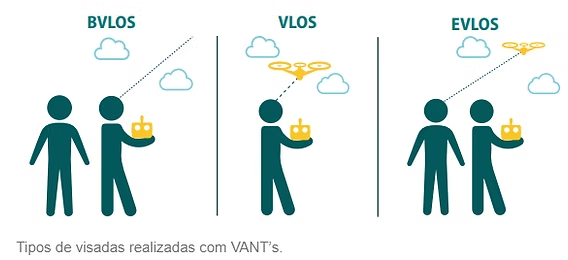
In the first part of our series of articles presenting the changes of SORA 2.5, the table describing the initial ground risk classes was presented. In addition to the qualitative vs. quantitative changes, however, there is another important element: in the case of ground risks, it is no longer relevant whether the operation is conducted in VLOS (within visual range) or BVLOS (beyond visual range). This, however, does not mean that it is not relevant in the case of air risks, but we will discuss this in a separate article.
This change clearly supports the implementation of BVLOS operations, but at the same time, the VLOS/BVLOS calculator previously developed by the German Federal Aviation Authority and used by aviation authorities in other member states has now become part of the AMC, so what qualifies as a BVLOS operation is now determined according to a uniform methodology throughout the European Union, and this methodology must be accepted by the national aviation authorities as an accepted means of compliance.
AMC starts one step further in answering the question of where the limit of VLOS lies. The use of the terms ALOS – Attitude Line of Sight and DLOS- Detection Line Of Sight is more appropriate for the human eye and the different sizes of drones.
ALOS indicates the distance at which the remote pilot is still able to perceive and determine the position and flight direction of the drone with the naked eye. DLOS shows the distance from which another aircraft can be detected with the naked eye. According to AMC, the smaller of the two distances gives the practical upper limit of VLOS. AMC also shows the upper limit of the ALOS and DLOS values, and the smaller of the two should be considered the upper limit of VLOS.
The basis of the calculations is always the largest characteristic dimension (CD – Characterising Dimension), which expresses that the size of the drone decisively influences whether an operation is still within visual range or not.
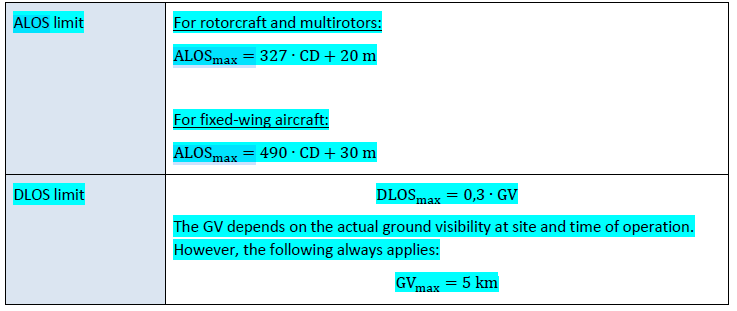
The figure below visually presents the values to be used for a typical multirotor drone.
