
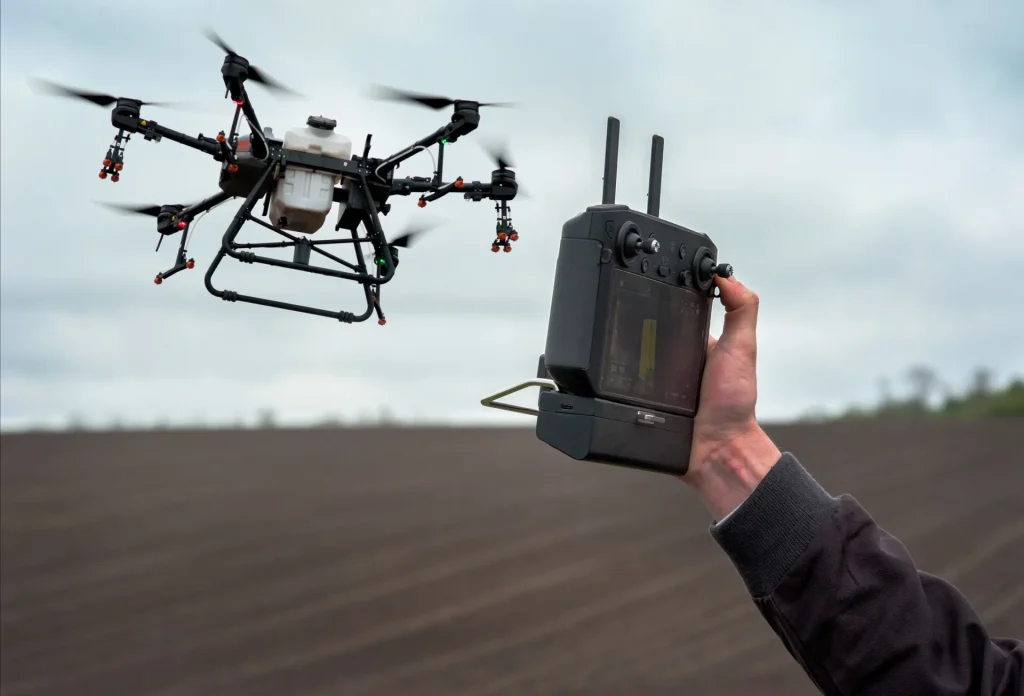
Based on recent information from Nébih and NAK, a total of eight products may now be applied in Hungary by unmanned aircraft, i.e. drones. In addition to the seven products previously authorized, Laminex LP-45 spray adjuvant has now received authorization for drone-based application. Laminex LP-45 is not a plant protection product, but a product with plant-protection effects, specifically a spray adjuvant.
The newly authorized product, Laminex LP-45, may be used in winter oilseed rape to reduce pod-shatter losses. According to Nébih, the product must be applied on its own during pod yellowing, 3–4 weeks before the expected harvest, when approximately 30% of the pods are already mature. In the “Products authorized for drone application” table, the application rate for Laminex LP-45 is 0.8–1.0 l/ha, and the phenological stage at application is BBCH 80–87.
List of products authorized for drone application (8):
- Mospilan 20 SG
- Coragen 20 SC
- Amistar Sun 325 SC
- Mimic
- Mospilan 120 SL
- Pictor Active
- Elatus Era
- Laminex LP-45 (spray adjuvant)
What does this mean in practice?
According to Nébih’s notice, the use of this technology remains subject to strict conditions. The unmanned aircraft may fly at a maximum height of 3 metres above the crop, its maximum speed may be 15 km/h, and during spraying it must be ensured that the 50% volume median diameter of the applied spray droplets is at least 200 µm. A 50-metre buffer distance must be maintained from the treated area, and the maximum permitted wind speed is 2 m/s.
For lawful operation, the drone used must have type certification, and the drone pilot must be included in the drone pilot register maintained by Nébih. According to Nébih’s information, spraying carried out by drone continues to qualify as aerial plant protection; therefore, it may only be performed under the supervision of a plant doctor (Section 10 of Joint Decree 44/2005 (V.6.) FVM–GKM–KvVM). In addition, before commencing the activity, authorization must be requested from the plant and soil protection department of the territorially competent county government office (Sections 3/A and 3/B of Decree 44/2005 (V.6.)). Before work begins, warning signs must also be placed at the boundary of the area and the protective buffer zone. From the aviation compliance perspective, depending on the circumstances of the operation, an operational authorization or an LUC certificate may also be required to carry out drone-based application.
Good news for drone-based plant protection
The expansion of the range of authorized products is good news for the practical adoption of drone technology, but the key to compliance remains unchanged: planning must always be based on the current official Nébih list, and the operation must be carried out in accordance with occupational safety, plant protection and airspace-use rules.
This article was prepared on the basis of the official information published by Nébih and NAK.