
After a lengthy preparation, the so-called AMC amendment containing SORA 2.5 was published on the European Aviation Safety Agency’s (EASA) website on September 29. The renewed AMC (Acceptable Means of Compliance) describes the new methodology for mandatory risk analysis in the special operation category, which must be applied uniformly throughout the European Union. Applications for new operational authorisations should now be submitted in accordance with SORA 2.5, while incumbent operational authorisations (including the documentation of LUC holders) must be brought into line with SORA 2.5 within two years, as per the EASA decision. In our series of articles, we will review the most significant changes affecting the methodology.
During drone operations, attention must be paid to the number of people exposed to the risks posed by the UAS operation in the operational volume and the surrounding ground risk buffer. This is called the ground risk footprint (iGRC footprint) in the risk analysis methodology.
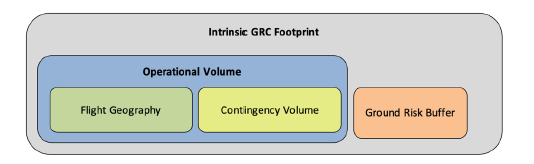
In addition, the operator must also pay attention to how many people are exposed to the risks of the drone operation in the adjacent area surrounding the operational volume.
The so-called containment conditions must be determined according to the nature of the adjacent area. SORA 2.5 has developed a more differentiated system for calculating the adjacent area. While SORA 2.0 considered the adjacent area to be the distance that can be covered in 120 seconds at the highest flight speed, in the case of the renewed methodology, the extent of the adjacent area must be determined as follows.
The adjacent area includes all areas that the drone can fly over at maximum speed in three minutes. If this distance is less than 5 km, the outer boundary of the adjacent area is 5 km from the edge of the ground risk buffer.
If the distance flown over three minutes exceeds 5 km, the calculated distance should be taken as a basis, but the outer boundary of the adjacent area should never be farther than 35 km from the edge of the ground risk buffer zone, even if the drone can fly more than 35 km in three minutes.
The operator should also calculate the population density in the adjacent areas. Based on the size of the drone, its speed and the population density of the adjacent area, a low, medium, or high level of robustness should be applied, which differs from the previous solution of SORA 2.0, which used basic and enhanced containments. In our next article, we will present the individual levels of containment’s robustness.