
Introduction
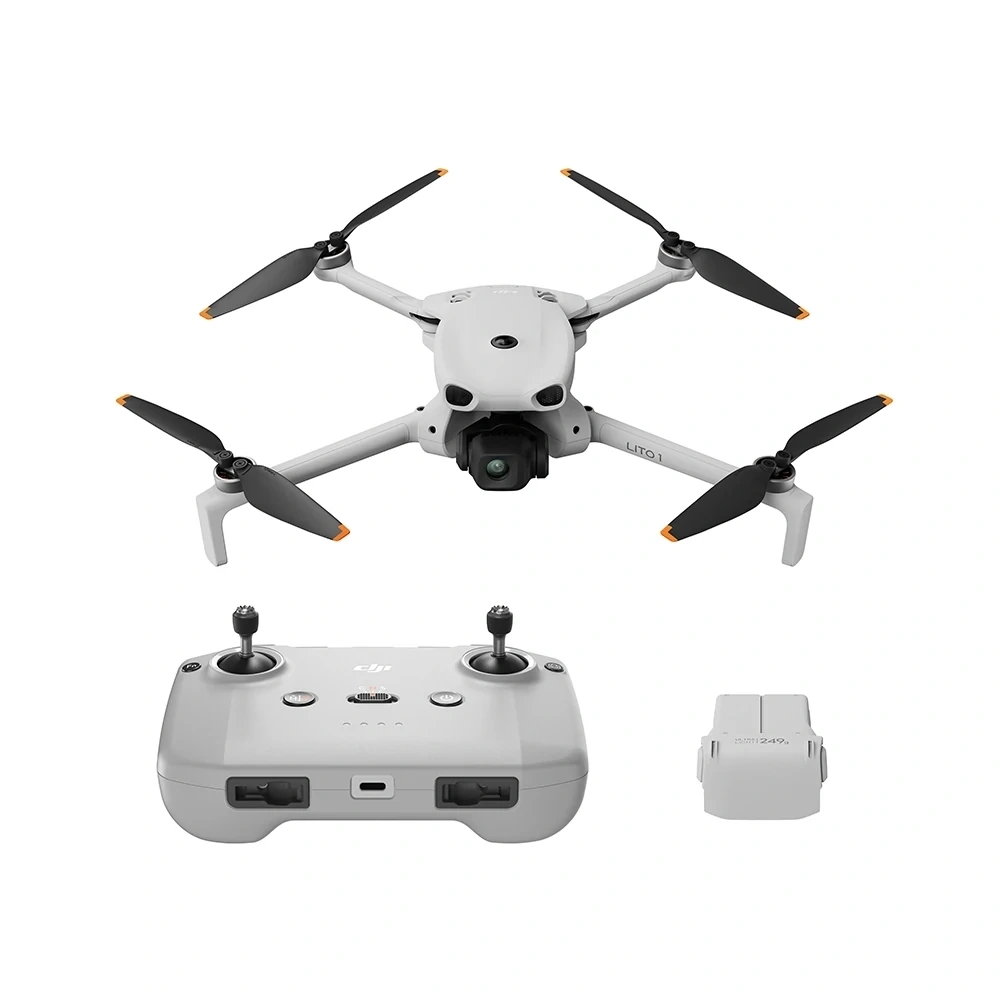
The manufacturer positions the DJI Lito X1 specifically for entry-level users: the aim is to significantly reduce the steep and resource-intensive learning curve of creating impressive aerial content, while avoiding compromises in flight-safety support and imaging. Based on DJI’s communication, the Lito X1 combines a 1/1.3-inch sensor, omnidirectional obstacle sensing and forward-facing LiDAR in a sub-249 g category.
1) Imaging: a strong foundation for content creation
According to the DJI Store description, the Lito X1 camera system uses a 1/1.3-inch CMOS sensor and an f/1.7 aperture, and supports 4K/60 HDR video, 4K/100 slow motion, and 2.7K vertical video. The Store description also states that in HDR mode it can reach up to 14 stops of dynamic range, which is a truly significant performance level for such a compact device.
In practice, the combination of the sensor and aperture is particularly useful when you want stable quality even under mixed lighting conditions, such as cloudy weather or sunset.
2) Flight safety: omnidirectional sensing + front LiDAR
DJI highlights that the Lito X1 is equipped with omnidirectional obstacle sensing and forward-facing LiDAR. The DJI Store description explains that LiDAR actively detects and avoids obstacles, such as buildings, along both the flight route and the return-to-home route, which can increase safety in urban environments and under lower-light conditions. The same source also states that, in good lighting conditions, the drone may be able to “memorize” flight routes and support faster take-off and safer return even without a satellite signal.
Important: sensors and automation do not replace the responsibility of the remote pilot. Assessing the environment and defining abort criteria, such as wind, people and obstacles, remain the pilot’s decision. The device can therefore support the drone pilot at most, but it cannot replace them.
3) Flight time in a sub-249 g device
According to DJI’s technical data, the Lito X1 can achieve a flight time of up to 36 minutes with the standard Intelligent Flight Battery, while the Plus battery may provide up to 52 minutes. This is a very significant operating time, even considering that only about 80% of it is realistically usable. At the same time, the specifications page notes that using the Plus battery may increase the drone’s weight above 249 g. Therefore, local rules must always be checked before flight, because in Europe, if the device exceeds the 250-gram threshold, it can no longer be classified as a C0-class aircraft.
4) EU C0 vs C1
The DJI Store clearly states that in Europe the certification class of the Lito X1 depends on the selected package. In the case of C0/UK0 combos, the Plus battery and propeller guards are not supported, because with these accessories the device would exceed the C0 category’s weight limit. In contrast, for the C1/UK1 version, such as the Fly More Combo Plus, these accessories can be used, since in the C1 category the maximum take-off mass must remain below 900 grams.
Practical takeaway: choosing the drone itself is not enough. The package, C0 vs C1, together with the accessories you plan to use, determines which configuration will be compatible with the class corresponding to the intended drone operation. In addition, a downgrade is not possible.
5) Quick CloudIA checklist before the first “LitoX” deployment
- Define the target operation: content creation, real estate, sport or travel. This determines the location and risk logic.
- Select the package, C0 vs C1, and check whether you plan to use the Plus battery and/or propeller guards.
- Before each flight, always check the local airspace structure and restrictions, and comply with the operating rules of the relevant country or area.