
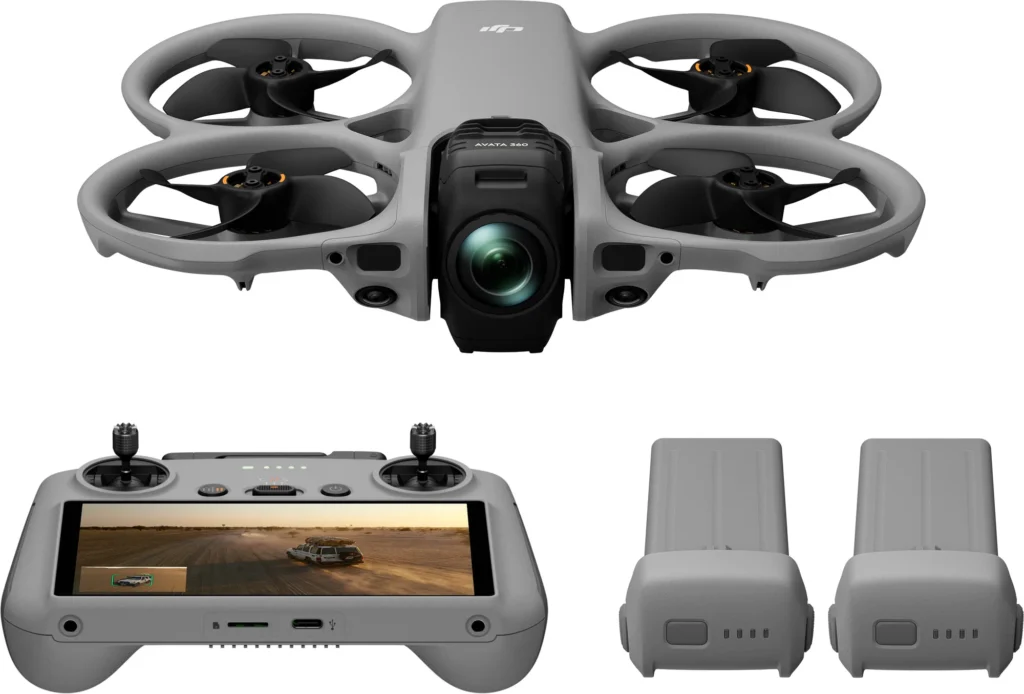
DJI introduced the Avata 360 drone on 26 March 2026, taking FPV flight and 360° aerial imaging to a new level. The main concept of the model is that the pilot is not limited to a single predefined camera view during flight, but can record a complete 360° visual environment. This means that the footage can be recomposed afterwards, allowing multiple perspectives, framings and content variations to be created from a single flight.
According to the manufacturer, the Avata 360 is capable of recording 8K/60 fps HDR 360° video, capturing 120-megapixel photos, using O4+ video transmission, and achieving up to 23 minutes of flight time. DJI also highlights omnidirectional obstacle sensing, the integrated propeller guard, and the fact that, in addition to 360° recording, the drone can also be used in single-lens mode, for example to create more traditional 4K/60 fps footage.
What Makes the Avata 360 Different?
In traditional drone footage, the direction of the camera largely determines what is captured. During the flight, the pilot must decide what the camera should show, where the gimbal should turn, and what movement the shot should follow.
360° recording, by contrast, provides greater freedom in post-production. By capturing the entire surrounding space, the user can later decide which direction the camera should “look” in the final video. From the same flight, it is possible to create a traditional wide-angle drone video, dynamic FPV-style footage, vertical content optimized for social media platforms, or even an interactive 360° presentation.
What Can It Be Used for in Practice?
The Avata 360 may be particularly interesting in use cases where visual impact, dynamics and post-production flexibility are especially important. These may include, for example:
- event and demonstration documentation,
- spectacular recording of sports events or technology competitions,
- presentation of tourist locations,
- visual documentation of industrial or agricultural environments,
- analysis of flight situations for educational purposes,
- creation of short videos optimized for social media.
360° recording makes it possible to create multiple communication materials from the same flight. For example, from a single event it is possible to produce a short social media video, a longer summary, an educational analysis, and a visually striking recomposed FPV-style video.
Regulatory and Operational Considerations
When a new drone model appears, many people first focus on its technical parameters: camera, resolution, flight time, transmission system and obstacle sensing. These are indeed important features, but from the perspective of safe and lawful drone use, it is not sufficient to consider only the technical capabilities.
In the European Union, most low-risk recreational and commercial drone operations fall under the open category, which EASA divides into the A1/A3 and A2 subcategories. According to EASA’s guidance, each subcategory is associated with different requirements, operating conditions and remote pilot competencies.
In Hungary, domestic registration obligations must also be taken into account. According to the information provided by the Aviation Authority, an unmanned aircraft system — with the exception of unmanned toy aircraft — may only use Hungarian airspace if it has been registered by the authority. The authority’s guidance treats the registration of the UAS operator and the UAS device separately.
Therefore, in the case of a device such as the Avata 360, the question is not only what the drone is capable of, but also who operates it, under what circumstances, for what purpose, and with what authorizations.
It is important to note that the device has an MTOM of 455 g and a C1 class identification label.
Data Protection Issues in the Case of 360° Recording
One of the greatest advantages of a 360° camera is also one of its most important risks: it sees much more than a traditional forward-facing camera. At an event, in a public area, at an industrial site or during an educational demonstration, not only the designated target area may be recorded, but also people, license plates, building details, internal processes or other information that may be considered sensitive.
For this reason, when creating 360° drone footage, it is especially important to define in advance the purpose of recording, the area being captured, the legal basis for data processing, the retention period, and whether masking, anonymization or restrictions on the use of the footage are necessary.
The technology therefore not only offers new creative possibilities, but also entails greater responsibility. The higher the resolution and the wider the angle of data collection, the more conscious the approach to data protection and operational planning must be.
Technology Alone Is Not Enough
The DJI Avata 360 clearly shows the direction in which the drone market is moving: devices are becoming smaller, smarter, capable of producing more spectacular footage, and increasingly combine flight, data collection and content creation. At the same time, technological development does not replace professional preparedness.
Safe drone use still requires appropriate remote pilot competence, operational planning, risk assessment, airspace knowledge, data protection awareness and knowledge of the current regulatory environment. An advanced camera or obstacle sensing system can be a useful aid, but it does not replace the responsible decisions of the operator and the remote pilot.
The article was prepared on the basis of DJI’s official product announcement of 26 March 2026, the official DJI Avata 360 product and technical datasheet, and the guidance issued by EASA and the Hungarian authority concerning the open category and UAS registration.