
Introduction
In aviation, knowing the rules is unavoidable. In the European Union, the regulatory framework is ensured through EU regulations, and EASA—acting as the umbrella authority above Member States—provides professional support to the legislative process.
In this article we present the regulatory environment and explain what it means in practice.
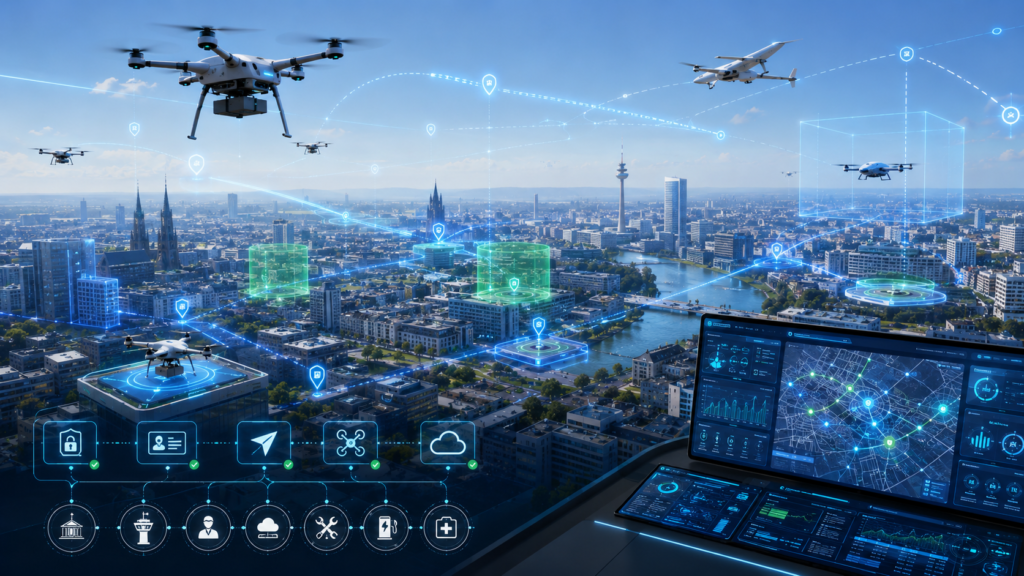
If you think of U-space as “a transport and traffic management system for drones”, then these three EU regulations are its ‘highway code’ and background rules. As an operator, it is useful to understand the essence: when you must use digital services, who you need to cooperate with, and what the system increasingly expects (data, logging, traceability). In reality, these are requirements that the user must be able to satisfy digitally through appropriate tools and systems.
1) 2021/664 – how U-space works
Regulation 2021/664 is the main framework. In short, it says:
- A Member State may designate U-space airspace—this is an option worth using, because it enables the provision of value-added services.
- In that airspace, certain operations may only be carried out using specific digital services (i.e., only with tools capable of meeting predefined functional requirements so that safe air traffic can be achieved).
- The key actors and roles appear (the competent authority, the U-space service provider/USSP, and information services). This matters because the airspace may be accessible to all users, but only those who meet the necessary requirements and receive the appropriate authorisation from the service provider may enter and perform a given operation.
- The common foundation is interoperable data exchange and traceability.
In U-space it is not enough to “fly in the right place” — you must fly well, plan well, and everything must leave an audit trail.
2) 2021/665 – how U-space integrates with air traffic services
Regulation 2021/665 is about how air navigation service providers (ATC/ANSP) should adapt to U-space, especially when U-space airspace is designated within controlled airspace.
Why does this affect you? Because where drones and manned aviation operate in the same environment, coordination becomes a system requirement. This influences which services you can access and under what conditions.
3) 2021/666 – manned aviation in U-space: making everyone “visible”
Regulation 2021/666 approaches the topic from the perspective of SERA (the European baseline rules of the air): how to enable safe operations for manned aircraft in U-space airspaces as well. This typically relates to communication and electronic conspicuity, so that conflicts between manned and unmanned traffic can be avoided.
4) What does this mean for you?
- There will be areas where the drone will not be able to operate without using the relevant services.
- Planning becomes more digital: flight intention, authorisation, traffic picture.
- Logging and traceability become more important.
- Customers increasingly demand “auditable operations”.
- Technology choice (aircraft + software + service provider) becomes a compliance question.
5) How to prepare for U-space-compatible operations
- Check where U-space may appear in your target areas.
- Build an internal process: planning → authorisation → flight → logging → incorporating lessons learned.
- Define roles (who is the responsible manager, who plans, who flies, who documents).
Reference:
EUR-Lex – (EU) 2021/664 https://eur-lex.europa.eu/eli/reg_impl/2021/664/oj/eng
EUR-Lex – (EU) 2021/665 https://eur-lex.europa.eu/eli/reg_impl/2021/665/oj/eng
EUR-Lex – (EU) 2021/666 https://eur-lex.europa.eu/eli/reg_impl/2021/666/oj/eng
EASA Easy Access Rules for U-space (May 2024)