
1. Space Weather and Satellite Navigation – Can Space Weather Influence It?
During the analysis of the flight events presented in the previous two parts, certain instability phenomena were identified that raise the possibility of external environmental factors, including space weather, playing a role. Based on flight logs, GNSS (Global Navigation Satellite System)-based positioning was used in both cases; however, instabilities were still observed during flight.
This justifies examining which less frequently considered environmental factors, in addition to technical and operational aspects, may influence the performance of satellite navigation systems.
The aim of this article is not to determine a single specific cause, but rather to place the observed phenomena into a broader environmental context. The focus is on geomagnetic activity – disturbances in the Earth’s magnetic field primarily caused by charged particles originating from the Sun – characterized mainly through the Kp index (one of the most widely used indicators of geomagnetic activity, expressed on a scale from 0 to 9), and its potential relationship with the performance of GNSS-based systems.
2. Fundamentals of the Relationship Between Space Weather and GNSS
GNSS systems, such as GPS (Global Positioning System), Galileo, or GLONASS (Global Navigation Satellite System), use radio signals transmitted from satellites in space to determine position on the ground or in the air. These signals travel from the satellites to the Earth’s surface through the ionosphere, a layer of the atmosphere containing electrically charged particles.
The state of the ionosphere is not constant. Solar activity, such as solar flares or coronal mass ejections, can significantly affect this layer. These phenomena are collectively referred to as space weather. When streams of charged particles reach the Earth, the structural stability of the upper atmosphere may change. This occurs during periods of geomagnetic activity, which can lead to several effects on GNSS signal propagation:
- ionospheric delay variation – changes in signal propagation time that may result in positioning errors
- signal-to-noise ratio degradation – a decrease in the ratio between useful GNSS signal and background noise, leading to reduced signal stability and, in some cases, signal loss
As a consequence of these effects, the accuracy and stability of GNSS-based positioning may deteriorate. In practice, this may appear as the drone’s position slightly “jumping” on the map while it is actually hovering in place, or slowly drifting away from its intended position without immediate detection by the pilot.
The stronger the particle flux or solar wind, the more pronounced these effects can become, as ionospheric disturbances increase in intensity.
These disturbances may manifest in the following ways:
- positioning accuracy degradation – the calculated position deviates from the true location, for example, the drone appears several meters away from its actual position on the map
- position drift – the position gradually shifts over time, causing the drone to appear to “move” on the map even when it is hovering
2.1. Solar Activity During the Examined Period
NOAA (National Oceanic and Atmospheric Administration) is a U.S. governmental organization responsible, among other things, for space weather observations and forecasting. Its Space Weather Prediction Center (SWPC) serves as the official U.S. center for space weather forecasting, providing real-time observations, forecasts, and alerts related to solar activity and geomagnetic events.
NOAA classifies space weather events using standardized scales based on solar activity intensity. One such classification is the S-scale (S1–S5), which describes the strength of solar radiation storms:
- S1 – minor
- S2 – moderate
- S3 – strong
- S4 – severe
- S5 – extreme
According to the aforementioned center’s report, during the examined period, on June 8, 2024, a moderate (S2) radiation storm developed following an M9.7 class solar flare. The “M” classification is based on X-ray intensity (on an increasing scale: A–B–C–M–X), where M-class flares are considered strong, and the numeric value (e.g., 9.7) indicates intensity within the category.
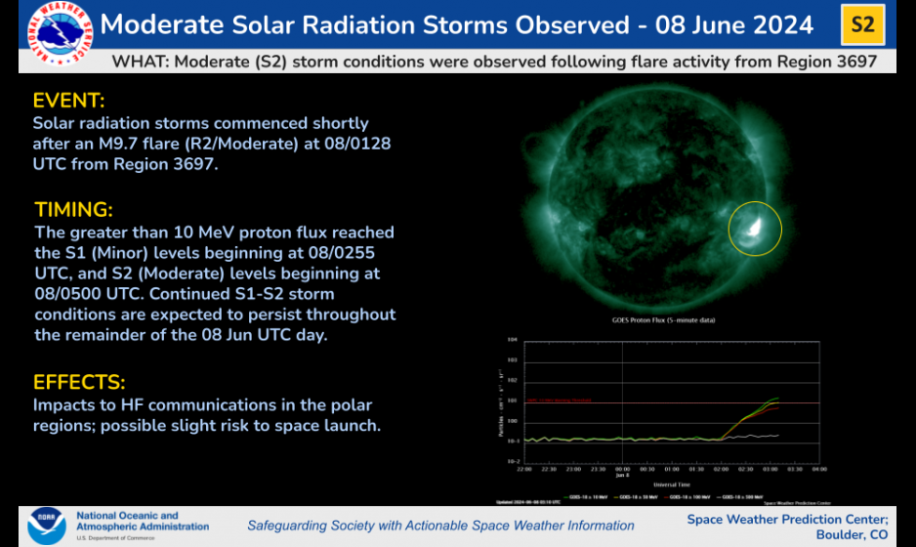
Figure 1: NOAA report on the radiation storm following the M9.7 solar flare observed on June 8, 2024. Source: NOAA SWPC
The S2 category corresponds to a moderate radiation storm.
This solar event is primarily relevant to the second flight case; however, it also indicates that the examined period was characterized by elevated solar activity and an active space weather environment.
Geomagnetic storms – which develop in the Earth’s ionosphere as a result of solar activity – are classified by NOAA using the “G” scale (G1–G5), which describes disturbances in the Earth’s magnetic field and can be related to Kp index values. While the “S” and “G” scales describe different phenomena, they are linked to the same solar activity events: solar radiation events are classified using the “S” scale, while the resulting geomagnetic storms observed on Earth are described using the “G” scale.
For practical interpretation of geomagnetic activity, the classification system used by NOAA’s Space Weather Prediction Center was applied, which links Kp index values to geomagnetic storm categories.
According to NOAA classification:
- Kp = 5 → minor geomagnetic storm (G1)
- Kp = 6 → moderate geomagnetic storm (G2)
- Kp = 7 → strong geomagnetic storm (G3)
- Kp = 8 → severe geomagnetic storm (G4)
- Kp = 9 → extreme geomagnetic storm (G5)
This is relevant for the examined cases, as it indicates that multiple, interconnected space weather phenomena may have been present during the flight events, potentially influencing the performance of GNSS-based systems.
The categories are based on the official space weather scales used by NOAA’s Space Weather Prediction Center.
The solar event observed on June 8, 2024 occurred close in time to the examined period. Regardless of this, elevated geomagnetic activity (Kp ≈ 6) was also observed on June 7, 2024, which will be analyzed in more detail in the following section.
A direct cause-and-effect relationship cannot be established; however, the temporal proximity justifies considering the space weather environment when interpreting the events.
The presented fundamentals demonstrate that GNSS-based system performance may be influenced not only by technical factors, but also by environmental effects, particularly space weather.
In the next section, specific data and measurements will be used to analyze how geomagnetic activity evolved during the two examined flight events.
Sources: